

Operations Research and Behavioral Informatics
ORβIT develops decision methods for socio-technical systems in which actors respond on their own terms, conditions evolve, and the timing and sequencing of decisions determine what remains possible.
Research Projects
All projects Active
Climate adaptation is often assessed by asking whether a measure works under current conditions. CLIMACT asks when it works, for whom, and for how long.
 Active
 Active
In response to the growing demand for sustainable and efficient transportation, integrating freight and passenger services offers a promising solution. This project aims to design an integrated system that appropriately balances the priorities of the involved stakeholders.
Despite their obvious similarities, passenger and freight transport are usually planned and operated separately. This project explores how these systems can work together more effectively.
Selected output
All research output
BibTeX
% VERIFIED; verified 2026-10-11
@article{orbit-b7a9b36bff7fbe36,
  title = {A decomposition-based matheuristic for the passenger-oriented integrated passenger-freight transport problem},
  author = {Li, Siqiao and Stokkink, Patrick and Cats, Oded and Saeednia, Mahnam},
  journal = {Transportation Research Part C: Emerging Technologies},
  year = {2027},
  volume = {194},
  part = {Part A},
  pages = {105996},
  eid = {105996},
  doi = {10.1016/j.trc.2026.105996},
  url = {https://doi.org/10.1016/j.trc.2026.105996},
  issn = {0968-090X, 1879-2359},
  publisher = {Elsevier},
  abstract = {Integrating passenger and freight transport has become increasingly important for improving the efficiency of urban mobility systems, as planning them separately often results in underutilized capacity and redundant vehicle movements. Coordinating the two enables more effective use of existing transport resources for public transport operators, helps logistics providers maintain cost-effective and reliable deliveries, and assists public authorities in alleviating urban congestion. When implementing such integration, railway stations play a key role as urban hotspots with limited access, where road-rail connections can facilitate efficient intermodal operations. In this work, we introduce a passenger-oriented pickup and delivery problem with explicit road-rail connections and a fleet of shared-use light vehicles. The problem is formulated as a mixed-integer linear program to jointly determine fleet size, routing, and scheduling plans, ensuring a balanced service quality for both passengers and freight. A decomposition-based matheuristic is developed that iteratively coordinates a routing-oriented master problem and a scheduling-oriented subproblem, with feasibility partially restored through a schedule-shifting strategy. The master problem is tackled using an adaptive large neighborhood search enhanced with variable neighborhood search, featuring a novel adaptive selection mechanism based on the relative contributions of service quality indicators. The resulting routing decisions are then passed to the scheduling subproblem, which is solved efficiently using a propagation-based approach that guarantees local optimality. Extensive sensitivity and benchmark analyses demonstrate the benefits of integrated transport in reducing delays, particularly in resource-constrained settings and across different passenger–freight demand compositions.},
  keywords = {Pickup and delivery problem, Integrated transport, Matheuristic, Adaptive large neighborhood search},
}
BibTeX
% VERIFIED; verified 2026-10-11
@article{orbit-5b40dc103a823723,
  title = {Service design for shared micromobility: Long-term planning under gradual user adoption},
  author = {Farhani, Mahsa and Rezaei, Jafar and Azadeh, Shadi Sharif and Maknoon, Yousef},
  journal = {Research in Transportation Business \& Management},
  year = {2026},
  volume = {69},
  pages = {101818},
  eid = {101818},
  doi = {10.1016/j.rtbm.2026.101818},
  url = {https://doi.org/10.1016/j.rtbm.2026.101818},
  issn = {2210-5395, 2210-5409},
  publisher = {Elsevier BV},
  abstract = {Service design for shared micromobility services, such as e-mopeds, involves decisions on service location, fleet size, pricing, and resource allocation, which are typically based on potential demand estimates. In practice, however, potential users adopt the service gradually, leading to market penetration over time. Ignoring this gradual penetration can lead to suboptimal decisions and service failures. We propose a phased optimization model to maximize profitability over a planning horizon divided into discrete periods. The model jointly determines service locations, fleet size, and spatio-temporal resource allocation while ensuring a targeted service level. To model gradual adoption, we apply an extended Bass diffusion framework in which adoption depends on service quality, defined by accessibility and availability, and social influence, reflecting the impact of current users on others’ adoption. The phased deployment strategy aligns service expansion and investment decisions with adoption growth (market penetration) over multiple periods. Applied to a bike-sharing case in Manhattan, the proposed approach improves resource allocation and increases profitability by up to 47\% compared with an upfront strategy under parameter misestimation. Furthermore, ignoring service quality in the adoption model leads to a profit loss of up to 54\% when user expectations are high The results shed light on the value of synchronizing service design decisions with user adoption dynamics.},
  keywords = {Bass diffusion, Phased planning, Service design, Shared micromobility, Social influence},
}
BibTeX
% VERIFIED; verified 2026-10-11
@article{orbit-acfda03c40168bfa,
  title = {Role of topology and recovery strategies on multi-dimensional resilience of road networks},
  author = {Balakrishnan, Srijith and Stokkink, Patrick},
  journal = {International Journal of Disaster Risk Reduction},
  year = {2026},
  volume = {144},
  pages = {106366},
  eid = {106366},
  doi = {10.1016/j.ijdrr.2026.106366},
  url = {https://doi.org/10.1016/j.ijdrr.2026.106366},
  issn = {2212-4209},
  publisher = {Elsevier BV},
  abstract = {This paper examines how road network topology and post-disruption recovery strategies jointly shape recovery processes following disruptions. We develop a scalable stress-testing framework to simulate disruption scenarios and generate recovery data for road networks, which is subsequently analyzed with regression models to identify the effects of structural characteristics, recovery strategy, and disruption severity on multi-dimensional resilience. Using 224 real-world road networks, we assess their post-disruption recovery across five resilience dimensions: operational efficiency, accessibility, local redundancy, global connectivity, and spatial fairness. The results yield three key insights with significant implications on infrastructure design and management. First, road network resilience is fundamentally multidimensional: no single recovery strategy consistently performs best across all dimensions. Second, topological characteristics influence recovery outcomes. Third, strategy-based recovery provides limited benefits under minor disruptions but substantially accelerates recovery under severe damage. These findings highlight the need for policies that integrate robust and diverse network design with post-disaster recovery planning for resilience management.},
  keywords = {Disaster resilience, Disruptions, Restoration, Statistical analysis, Topological metrics, Urban transport planning},
}
BibTeX
% VERIFIED; verified 2026-10-11
@article{orbit-775908644fcf5cd8,
  title = {Time Preference in Decisions With Recurring Payoffs},
  author = {Gülüm, Pelin and Maknoon, Yousef and Montibeller, Gilberto and Rezaei, Jafar},
  journal = {Journal of Behavioral Decision Making},
  year = {2026},
  volume = {39},
  number = {4},
  eid = {e70091},
  doi = {10.1002/bdm.70091},
  url = {https://doi.org/10.1002/bdm.70091},
  issn = {0894-3257, 1099-0771},
  publisher = {Wiley},
  abstract = {ABSTRACT Time preference plays a central role in decision‐making, shaping how individuals value outcomes that occur at different points in time. While most research on time preference focuses on one‐off payoffs, many real‐world decisions generate recurring consequences that unfold continuously over time. Despite their prevalence, little is known about how recurring payoff structures influence intertemporal preferences. We propose that recurring payoffs reduce discounting by promoting temporal integration. By highlighting the continuity of future consequences, recurring payoffs encourage individuals to form a more temporally integrated representation of outcomes rather than evaluating consequences as isolated events. Drawing on the choice isolation argument and the literature on choice bundling and choice bracketing, we argue that this representation reduces the salience of immediate‐versus‐delayed trade‐offs and ultimately lowers discount rates. We test this hypothesis in two experiments involving 284 individuals. Participants completed intertemporal choice tasks in either the gain or loss domain, with choices varying along two additional dimensions: payoff structure (one‐off vs. recurring) and outcome magnitude (small vs. large). Results revealed significantly lower discounting in recurring payoff conditions than in comparable one‐off conditions. The findings are consistent with the proposition that recurring payoff structures encourage a more temporally integrated evaluation of future outcomes, leading individuals to place less weight on immediacy when making intertemporal choices. This study extends the time‐preference literature by introducing recurring payoff structures as a distinct class of intertemporal outcomes and identifying temporal integration as a potential mechanism through which payoff structure influences discounting. It further demonstrates that the magnitude effect extends to recurring payoff environments, suggesting that outcome size continues to shape discounting even when consequences unfold repeatedly over time. These findings suggest that making the recurring nature of future consequences salient may be a promising avenue for promoting more future‐oriented decision‐making.},
  keywords = {discount rate, recurring payoffs, temporal integration, time preference},
}
BibTeX
% VERIFIED; verified 2026-10-11
@article{orbit-84189f25b1924300,
  title = {Intertemporal Judgements in Multi‐Attribute Decision‐Making: Biases and Mitigation Ideas},
  author = {Gülüm, Pelin and Maknoon, Yousef and Rezaei, Jafar},
  journal = {Journal of Multi-Criteria Decision Analysis},
  year = {2026},
  volume = {33},
  number = {2},
  eid = {e70035},
  doi = {10.1002/mcda.70035},
  url = {https://doi.org/10.1002/mcda.70035},
  issn = {1057-9214, 1099-1360},
  publisher = {Wiley},
  abstract = {ABSTRACT Intertemporal judgements are susceptible to biases that can distort evaluations and lead to inconsistent choices. While time‐related biases have been studied extensively from a descriptive perspective, little attention has been given to prescriptive approaches and the complex trade‐offs involved in multi‐attribute decision‐making (MADM). This study provides a comprehensive review of the effects of such biases on the MADM process. Drawing on evidence from behavioural economics, psychology, and decision analysis, we identify six time‐related biases and analyse the vulnerabilities they can introduce at each step of the MADM procedure. We also outline preliminary ideas that may help analysts and decision‐makers reduce these biases in the unique context of intertemporal multi‐attribute problems. Our findings highlight the importance of addressing biases from the earliest stages, such as problem structuring, and underscore the need for further empirical research to test and refine these proposed strategies.},
  keywords = {cognitive biases, intertemporal discounting, multi-attribute decision-making, time preference},
}
People
All people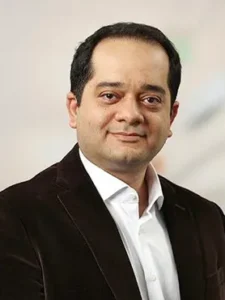
Yousef Maknoon
Associate Professor in the Faculty of Technology, Policy and Management at TU Delft. His research develops methodological approaches to decision-making, combining operations research, behavioural modelling and data-driven methods, with applications in transport, logistics and supply chains. Before joining TU Delft, he was a postdoctoral researcher at the Transport and Mobility Laboratory at EPFL and a postdoctoral fellow at Polytechnique Montréal–CIRRELT. He obtained his Master's and PhD in Industrial Engineering from Polytechnique Montréal.
View profile
Patrick Stokkink
Assistant Professor at the Faculty of Technology, Policy and Management at Delft University of Technology. His research focuses on large-scale heuristic and exact optimization of socio-technical systems, with primary applications in transport and logistics. He obtained his Master's degree in Operations Research from Erasmus University Rotterdam and his PhD in Civil Engineering from École Polytechnique Fédérale de Lausanne.
View profileResearch Opportunities
Current MSc thesis projects available with ORBIT.
View all opportunitiesA Multi-Factor, Empirically Weighted Cyclist Safety Indicator for Amsterdam
Develop and validate a link-level cyclist-safety indicator by combining crash, traffic, infrastructure, land-use, activity, and perceived-safety data.
Hubs and Cargo-Bike Fleets for Expanding Zero-Emission Zones
Jointly plan hub locations and cargo-bike fleet composition as Amsterdam's zero-emission zone expands and delivery needs change.
Safer Route Planning for Delivery Couriers
Compare individual and coordinated courier routing to understand how route guidance, incentives, and fleet-wide assignment can reduce risk on Amsterdam's cycling network.
News & events
All news & events EventsInternational seminar on urban transport accompanies Sara Momen’s PhD defenceAn international seminar on urban transport, featuring Professors Michel Bierlaire and Ilke Bakir, will take place at TU Delft on 14 October, ahead of the PhD defence of ORBIT researcher Sara Momen.Read article
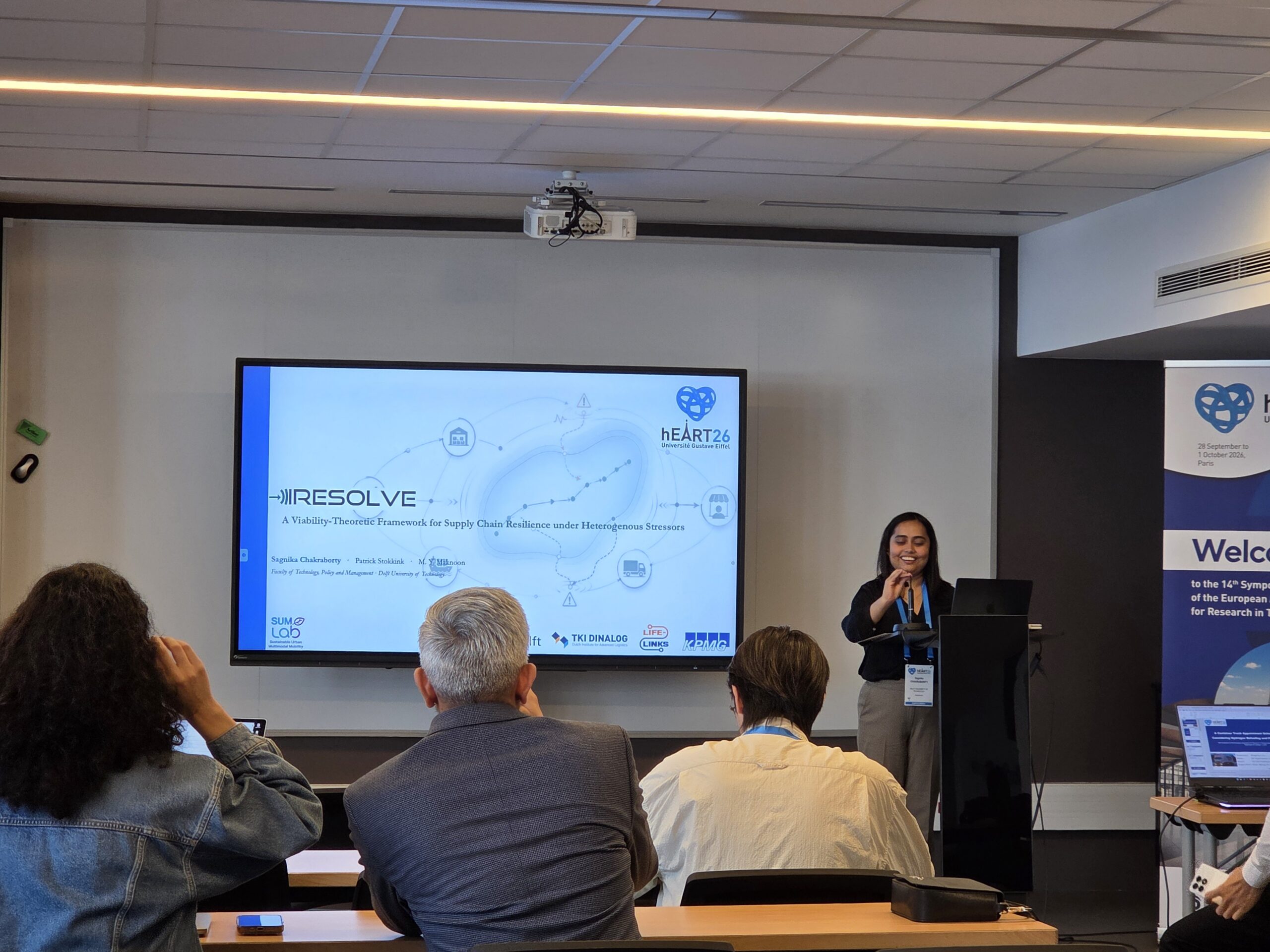 EventsORBIT researchers present at hEART 2026ORBIT researchers presented work on supply-chain resilience, food-delivery rider safety, and reliable multimodal trip planning at hEART 2026 in Paris.Read article
 RecognitionPatrick Stokkink awarded NWO Veni grantPatrick Stokkink has received an NWO Veni grant for COMPACT, which investigates how passenger and freight transport providers can share underused transport capacity more effectively.Read article